The Mercator International Opportunity Fund Summer of 2023 Update
The Mercator International Opportunity Fund Summer of 2023 Update
The Mercator International Opportunity Fund Summer of 2023 Update
Famed investor Benjamin Graham once said that markets can be a weighing machine in the long term, reflecting reality. But in the short term they can be a voting machine, expressing what investors think will happen.

The second quarter of 2023 was an example of the markets acting as a voting machine quickly followed by a reality check. The many companies we hold in the fund that published their quarterly review reports in July told a story different from what their stock price movement suggested. At the same time that their business were thriving, their stock prices continued to be under pressure. Then shortly after the quarter ended, they got a major bounce.
For more than 18 months now, high-quality growth stocks have drifted lower even though their underlying businesses have performed exceptionally well. Investors continued to vote down “growth” in favor of “value”. We think this rotation may have finally come to an end. Long-term fundamentals cannot be ignored forever.
The biggest surprise to us has been the magnitude of these moves, both on the way up and on the way down. Three years ago, the digital revolution got a huge boost from lockdowns forced upon people all around the world. Growth stocks benefiting from these extraordinary measures had to be bought at any price. Once COVID subsided, the reverse happened. Money flowed out of growth stocks with no consideration for individual companies’ fundamentals or valuations.
Let’s illustrate this with three charts of stocks we have been involved with. They are representative of the enormous and unprecedented volte-faces in the stock markets of recent quarters.
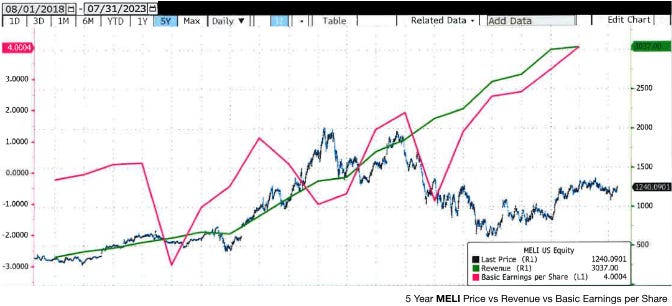
We always liked MercadoLibre (MELI; 4.79% of the fund), often referred to as the Amazon (the US eCommerce giant, not the river) of Latin America—but felt the valuation was excessive. At the height of the COVID eCommerce bubble, the stock traded at 25 times revenues (and an EV to revenues of more than 20).
A combination of continued rapid sales growth and a sharp correction from over $2,000 to $1,200 brought the EV/revenue multiple down to less than 5. The stock stabilized briefly and we started building a position. However, the selling pressure on growth stocks soon resumed. MELI went down another 50%. The good investment became a bargain and we kept adding to our position all the way down to $600.
The business, meanwhile, never slowed down. On the contrary, management added an even faster-growing fintech business to their dominant eCommerce position. The chart above shows this unbroken revenue growth record, rising at a 50%+ angle from the lower left corner to the top right one. While the business has been remarkably steady in its pursuit of growth, the stock has acted as if it went from boom to bust to boom. Investors’ emotional—even irrational behavior—in the face of MELI's remarkable business fundamentals has given us a great long-term opportunity. MELI is one of the two largest positions of the fund at this point.
Materialise (MTLS; 1.64%) is an even more stunning story.
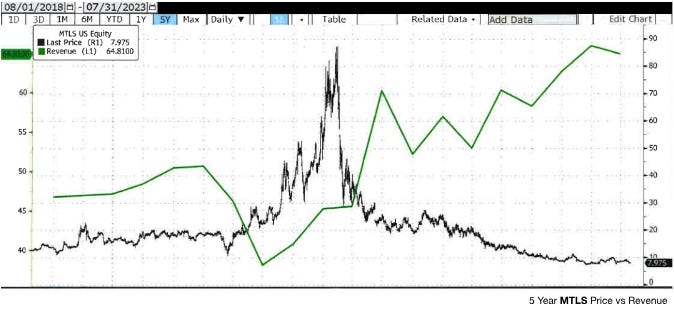
The Belgian company is a leading 3D printing software and services company. With a compound annual growth rate in the mid-teens, MTLS is by no means a fast-growing company. Yet, the stock shot up to stratospheric levels in 2020, probably because it was deemed a “transformational” company. It went from a price in the mid-teens to $80 in less than a year. We were lucky enough to sell our stocks close to the high, when it was trading at an eye-popping 18 times revenues. The stock dived shortly after that.
Here again, the fundamentals of the company never changed. It thus seemed to make sense to buy the stock again once the valuation was back in line with its growth prospects. With an average cost of $17, we thought we had made a great trade. The price has fallen another 50% since then, even though Materialise’s business in the medical segment is particularly vibrant and promising.
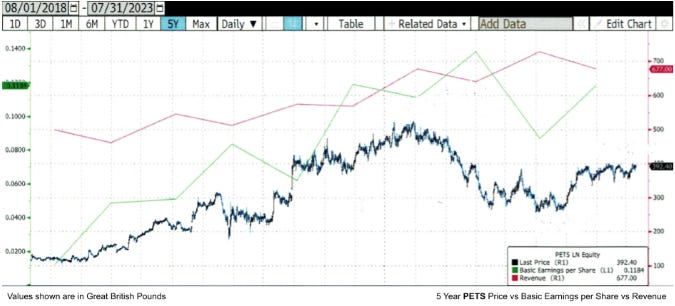
Pets At Home (PETS:LN; 1.95%) is a classic GARP stock. Two years ago, we made a conscious move out of the overvalued tech stocks into a number of GARP stocks. We liked the “At a Reasonable Price” part of the GARP definition. As we have discussed previously, unfortunately GARP stocks fell out of favor as well. Growth At a Reasonable Price just became cheaper while delivering consistently on their guidance.
Are Fundamentals Finally Being Recognized?
The magnitude of the moves, up and down, has been unprecedented. This we can only explain by the excessive liquidity in global markets due to years of Quantitative Easing.
The Fed's sharp reversal of monetary policies seems to have caused a reaction as violent as the original liquidity-driven bull market. The momentum that carried growth stocks to unreasonable valuations on the way up has now carried them down to levels implying an imminent collapse with no recovery in sight. Valuations of many growth stocks have fallen with a vengeance, especially in overseas markets. In the US, this is somewhat mitigated for holders of US indexes by the popularity of a small number of large cap stocks, often referred to as the “Magnificent Seven”.
Market inefficiencies are not new, of course. Benjamin Graham discussed them. Eventually, as he explained, company fundamentals prevail over all sorts of macro-economic, geopolitical concerns or mere trends and fads. We believe the excellent reports published by the companies held in the fund in July may be the beginning of renewed focus on such companies’ fundamentals.
Bengo4 (6027:JP; 2.38%), the owner of Japan’s equivalent of DocuSign, reported an increase of 67% in profits year-on-year. Suzuki’s (7269:JP; 1.08%) sales and profits were better than forecast, up 13.7% and 20.3% respectively, largely thanks to their sales in India. British retailer Watches Of Switzerland (WOSG:LN; 5.98%) benefited from a 52% increase in sales in North America to publish an overall revenue increase of 25% as well as a 26% jump in profits in spite of large investments in growth opportunities. Leading German silicon carbide equipment maker Aixtron (AIXA:GR: 2.45%) saw revenues grow 69% YoY combined with an increase of 125% in earnings. The British luxury car manufacturer Aston Martin (AML:LN; 2.94%) declared mission accomplished in the turnaround of their business; revenues were up 25%, driven by strong SUV sales and by higher ASP (average selling prices).
Good quarterly reports kept coming in August. MercadoLibre beat consensus yet again with net revenues growing at 57% YoY. The Japanese leader in electric motors Nidec (6594:JP; 1.89%) reaped the benefits of their aggressive cost cutting in the form of a 51% jump in pre-tax earnings. Japan’s semiconductor equipment company Lasertec (6920:JP; 1.75%) saw sales grow 69% and net profits up 85%.
With numbers like these, one would expect these companies to trade at higher multiples. Of course, a major recession—if it ever happens—may slow down the companies’ short term prospects. However, it is in hard times that the “best in class” grow market share at the expense of the weak. That’s when a premium is deserved, not a discount.
Already some private investors are taking advantage of publicly traded corporations' mis-priced assets. Last year, Mercator owned leading German 3D-printing company SLM Solutions was taken private at a nice premium. In the recent quarter, one of favorite holdings, Norwegian online game-based learning platform Kahoot!, was also taken private by a consortium led by Goldman Sachs. More M&A activity can be expected at today’s levels.
A Tectonic Shift In Japan
Finally, in that connection, there is an underreported tectonic shift happening in Japanese business culture. Any young investor who looks at the Japanese stock market for the first time learns how Japan is different in two important ways: employment is for life, no matter what, and hostile takeovers are not the Japanese way. One of these two tenets is about to change. Jobs may still be secure, but Japanese regulators are about to let Nidec finalize the first unwelcome takeover in Japanese modern history. If such takeovers become common, it will have huge implications for productivity and valuation. We are watching this unfold as Nidec management tells us other Japanese privately cheer for their success. This should at last open the way to a major restructuring of Japan Inc.
Hervé van Caloen, CIO
___
The MSCI EAFE Index is designed to represent the performance of large and mid-cap securities across 21 developed markets, including countries in Europe, Australasia and the Far East, excluding the U.S. and Canada. The Index is available for a number of regions, market segments/sizes and covers approximately 85% of the free float-adjusted market capitalization in each of the 21 countries.
Investors should carefully consider the investment objectives, risks, charges and expenses of the Fund. This and other important information about the Fund is contained in the prospectus, which can be obtained by calling 800-869-1679 or at www.mercatormutualfunds.com. The prospectus should be read carefully before investing.
The Fund is distributed by Arbor Court Capital, LLC, member FINRA/SIPC. Arbor Court Capital is not affiliated with Mercator Investment Management, LLC.